 |
 |
|
 |
 |
About Us | Contact |
|
|
International guidance levelsScience index » Overview | Article library | List of studies | Basic guide to EMFs | International guidance levels | Unit conversion | Frequently asked questions | Other resources
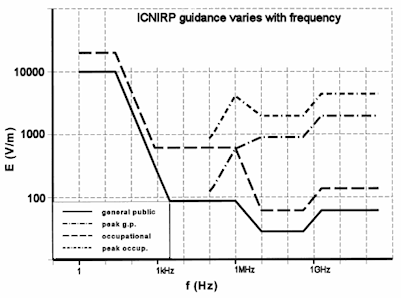
Their maximum exposure guidance levels vary with frequency and the place where people are exposed. This can be seen in the graph on the right hand side. These levels are set to protect against direct effects such as electric shock and body tissue heating. ICNIRP do not consider that the available scientific evidence regarding reported adverse health effects at lower exposure levels justifies a more precautionary attitude. This advice now differs from a number of other authorities who have chosen to issue more precautionary maximum advisable public exposure levels for chronic (i.e. long-term) involuntary exposure. ICNIRP have recently produced an excellent statement on emf-emitting new technologies covering all aspects of the rapid proliferation of RF emitting devices in the last few decades. Microwave FrequencyThe table below shows a comparison of guidance from various authorities for the frequency of 1800 MHz. In fact, the more precautionary levels are usually specified to cover all the mobile phone and digital cordless phone frequencies. The varying levels in the ICNIRP table were primarily due to the heating effects of radiofrequency radiation and as the more precautionary levels are below measurable heating, there is no need for different values for different frequencies. As 'volts per metre' is not a unit that most people are familiar with, we have arbitrarily taken the 1998 Salzburg level of 0.6 V/m as being 'equivalent to' a 30 mph vehicle speed limit in residential areas and then scaled the other levels relative to this. It is easy to see that the ICNIRP guidance is not very precautionary.
Note that it is very rare indeed for broadcast radio signals to exceed 1 V/m inside residences, with VHF/UHF ones rarely exceeding 0.05 V/m, being typically less than 0.01 V/m. Mobile phones can work down to less than 0.00003 V/m. Note also that The Power Flux Density (PFD) value only converts into the volts/metre value for continuous signals (like VHF FM radio signals). PFD, by its definition, relates to the average power (ICNIRP specifies that it should be averaged over 6 minutes) and is often much lower in mobile phone mast (etc) signals than is found in the short peak signal strength in the pulsing radiation. Most precautionary authorities believe that it is the peak power than matters and that the V/m figure should be taken as the peak value that should be allowed. On the available evidence, Powerwatch believes that signal strengths in bedrooms should be as low as possible and definitely below 0.05 V/m. The results from a study by some German GPs shows that adverse health symptoms were found in their patients at and above this level. See also our Bamberg story. A Spanish study also found significant health effects from exposure to 0.05 V/m. Levels below 0.05 V/m can be difficult to achieve, especially within a few hundred of metres of mobile phone masts. Some degree of screening is usually necessary. Footnote:Note that while the HPA-RPD website is very good for physics based factual information, Powerwatch believes that a far more precautionary response regarding involuntary human exposure is needed than the one currently expressed in public by the HPA-RPD.
This page has links to content that requires a .pdf reader such as | |||||||||||||||||||||||||||||||||||||||||||||||||||||||||||||||||||||||||||||||||||||||||||||||||||||||||||||||||||||||||


 The main international guidance comes from the