|
 |
|
 |
 |
About Us | Contact |
|
|
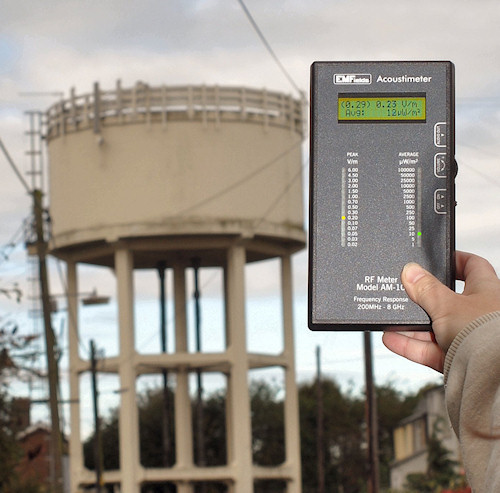
Mobile phone masts (base stations)Radiofrequency EMFs index » Overview | WiFi | Mobile phones | Cordless phones | Phone masts | Other resources There are over 70 million mobile phones in use in the UK. They are being used more and more as the phone companies offer lots of cheap/free time deals. Most network operators claim that they cover more than 99% of the UK population, covering the country in a blanket of electrosmog. Many people living near masts are experiencing increasing health problems at levels as low as 0.05 volts per metre, especially sleep disruption, headaches, tiredness, behaviour changes in children, epilepsy, nosebleeds, skin complaints. This Bamberg report is well worth reading:
The UK government received 22.6 billion pounds from selling the 3rd generation licences in 2000, and total mobile phone related tax revenue now exceeds 20 billion pounds per year. Neither Government nor industry wants to restrict the use of phones or the location of the base stations. There are many factors that affect the signal levels at any location. These include the number of operators and systems; the tilt and angle of the antennas; the geography of the area and the distance the base-station needs to cover. Microwaves are reflected off flat surfaces. The level of microwaves in an area will depend on things like metal roofs, lamp posts and other structures, building materials and structural additions, cars and lorries, etc. The only way to know for certain how a particular place, such as a house, flat, school or workplace, is affected by environmental microwave radiation is to measure the exposure. Many people do not know how many masts there are near them. There is a UK government website which has a reasonably accurate map of the masts currently integrated into the national network. Details are only put up when the mast is up and running. Ofcom, which maintains the site, depends on the phone operators to give them accurate information about the base station. They update the site every 3 months (or so). We have found inaccuracies with respect to the existence, siting and information included on the database - and we have not looked at many places. Do not accept the information as definitive or accurate. There is a long-running, ongoing, dispute between the UK Information Commissioner, Ofcom and T-Mobile about whether the full Sitefinder database should be downloadable. T-Mobile still is not supplying updated information and joins Ofcom in court as a representative of the rest of the mobile industry. In the meantime, Ofcom has been holding discussions with operators, which have now resulted in a resumption of voluntary provision of this data. 3, O2, Orange, Vodafone, Airwave and Network Rail all supply data to Ofcom at approximately three month intervals (T-Mobile has refused to do so since 2005). There is a lot more information on mobile phones, their masts and health effects freely downloadable from our article library. There is a unit conversion document (with integrated calculator) and an updated international maximum exposure guidance levels document. There is also an excellent memorandum (40KB PDF) written by Alan Meyer (for Mast Action UK) regarding "Local Government Responsibilities" towards exposure to masts. Planning LawsEquipment on masts over 15 metres high, and other limited, special circumstances, need full planning permission. Small additional changes do not need permission. Several companies can share a mast or site. Lower height antennas, including those mounted on lamp-posts do not need full planning permission. When an application for a new mast is made, people have only 56 days to respond. This time limit is very strict and many applications have gone through because the time has expired. It is important to find out as much as you can, as quickly as possible, if you wish to lodge an objection. There is a lot more information one mobile phones, their masts and health effects freely downloadable from our article library. Published research into mobile phone base station health effectsThe following are links into some research finding strong evidence that phone mast emissions may well be having detrimental effects on the exposed population. Please also see our list of relevant scientific studies. Research involving humans - cancer1. P
Wolf R, Wolf D, (April 2004) Increased incidence of cancer near a cell-phone transmitter station, International Journal of Cancer Prevention, 1(2) April 2004 [View Author's abstract conclusions]
2. P
Eger H et al, (November 2004) The Influence of Being Physically Near to a Cell Phone Transmission Mast on the Incidence of Cancer, Umwelt Medizin Gesellschaft 17,4 2004 [View Author's abstract conclusions]
Research involving humans - non-cancer3. P
Augner C et al, (September 2008) GSM base stations: Short-term effects on well-being, Bioelectromagnetics. 2008 Sep 19. [Epub ahead of print] [View Author's abstract conclusions] [View
on Pubmed]
4. P
Preece AW et al, (June 2007) Health response of two communities to military antennae in Cyprus, Occup Environ Med. 2007 Jun;64(6):402-8 [View Author's abstract conclusions] [View
on Pubmed]
5. P
Abdel-Rassoul G et al, (March 2007) Neurobehavioral effects among inhabitants around mobile phone base stations, Neurotoxicology. 2007 Mar;28(2):434-40 [View Author's abstract conclusions] [View
on Pubmed]
6. P
Yurekli A et al, (2006) GSM base station electromagnetic radiation and oxidative stress in rats, Electromagn Biol Med 25(3):177-88 [View Author's abstract conclusions] [View
on Pubmed]
7. P
Bortkiewicz A et al, (2004) Subjective symptoms reported by people living in the vicinity of cellular phone base stations: review, Med Pr. 2004;55(4):345-51 [View Author's abstract conclusions] [View
on Pubmed]
8. P
Nikolova T et al, (October 2005) Electromagnetic fields affect transcript levels of apoptosis-related genes in embryonic stem cell-derived neural progenitor cells, FASEB J. 2005 Oct;19(12):1686-8 [View Author's abstract conclusions] [View
on Pubmed]
9. P
Santini R et al, (September 2003) Symptoms experienced by people in vicinity of base stations: II/ Incidences of age, duration of exposure, location of subjects in relation to the antennas and other electromagnetic factors, Pathol Biol (Paris). 2003 Sep;51(7):412-5 [View Author's abstract conclusions] [View
on Pubmed]
10. P
Navarro EA et al, (December 2003) The Microwave Syndrome: A Preliminary Study in Spain, Electromagn Biol Med 22(2-3): 161-169 [View Author's abstract conclusions]
11. P
Santini R et al, (July 2002) Investigation on the health of people living near mobile telephone relay stations: I/Incidence according to distance and sex, Pathol Biol (Paris) 2002 Jul;50(6):369-73 [View Author's abstract conclusions] [View
on Pubmed]
REFLEX Report - Risk Evaluation of Potential Environmental Hazards From Low Frequency Electromagnetic Field Exposure Using Sensitive in vitro Methods. A project funded by the European Union under the programme "Quality of Life and Management of Living Resources" * Please be aware that this is a large file and may take some time to download Research involving animals11. P
Everaert J, Bauwens D, (2007) A possible effect of electromagnetic radiation from mobile phone base stations on the number of breeding house sparrows (Passer domesticus), Electromagn Biol Med. 2007;26(1):63-72 [View Author's abstract conclusions] [View
on Pubmed]
12. P
Balmori A, (October 2005) Possible Effects of Electromagnetic Fields from Phone Masts on a Population of White Stork (Ciconia ciconia), Electromagn Biol Med 24: 109-119, 2005 [View Author's abstract conclusions]
Other Articles
Lloyd Morgan has produced the following three articles. The first link is intended for reporters, editors and EMF health activists, with the intention of educating readers how to intelligently interpret EMF Science papers and provide a precautionary approach to the situation that would not result in needing to lose cellphones. It discusses all the peer-reviewed science studies through Nov. 2004, on the risk of brain tumors of various types from cellphone use. The second link is a report given to an organization of American doctors. It discusses the previously published risk of leukemia and brain tumor from power frequency EMFs and reports on findings how transients from power frequency EMFs are linked to increases in blood glucose and asthma in school children. The third article is a good overview of the health implications of EMFs in an FAQ format, including references:
This page has links to content that requires a .pdf reader such as |